


A natural oil that finally stops hair from growing back, right at the root with results just as strong as laser, but with zero pain, zero burns, and no risk of making things worse.
Couldn't load pickup availability
A cold-pressed botanical oil whose active compounds, cyperene and beta-selinene, block 5-alpha reductase at the follicle. Carried in a base of jojoba, sweet almond, rosehip and aloe, with tea tree and acetyl tripeptide-1.
3–5 drops, twice daily, massaged into clean, dry skin until absorbed.
Brianna N, 29
"I thought this was gonna be another oil that does nothing. but my body hair is actually growing back thinner and slower after like 2 months?? no burns, no $400 laser bill either"


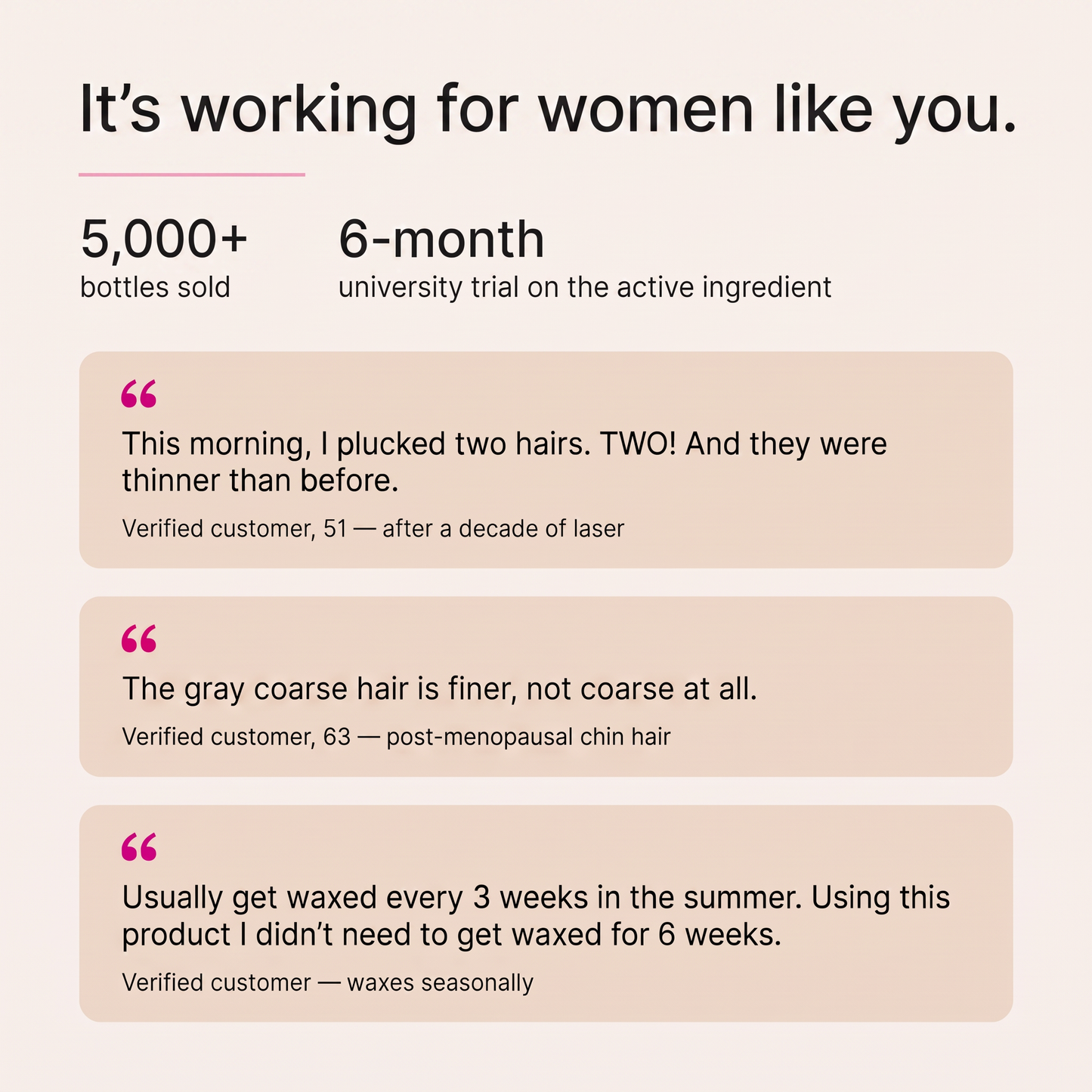
Others remove the hair. This blocks the signal
Every other thing you've tried works on the hair. This works on the instruction that grows it

Others remove the hair. This blocks the signal
Every other thing you've tried works on the hair. This works on the instruction that grows it
-
target
Targets the actual cause
Blocks 5-alpha reductase, the enzyme converting testosterone into the DHT that turns soft peach fuzz into coarse terminal hair. Everything else removes the hair. This starves what grows it. -
Matched A $100,000 Laser In Clinical Trial
A randomized 6-month trial at Suez Canal University found identical hair reduction to an Alexandrite laser. The laser caused pain and redness in 90% of patients. The oil, in none. -
Can't Touch Your Hormones
It works locally at the follicle, never through your bloodstream, so there's nothing for your cycle or mood to react to. And with no heat, it can't trigger paradoxical hypertrichosis the way laser does.
The Follicle Starvation Formula
One active blocks the hormone. The other seven repair the damage it took to get here.

Cyperus Rotundus Oil

Tea Tree Oil

Jojoba Oil

Sweet Almond Oil

Rosehip Oil

Aloe Vera Extract

Vanillin Extract

Acetyl Tripeptide-1
How to use
It slots into the routine you already have. You're not adding a ritual, you're ending one.

Shave, wax or pluck the hair
Your routine doesn't change, this is what goes on afterward.

A few drops. Massage in gently.
Two for the face, more for legs or chest; enough to absorb, not enough to feel greasy.

Let it absorb. Repeat tomorrow.
It sinks in within a minute, makeup goes on top of it fine, and twice a day every day is the whole mechanism.
Shave, wax or pluck the hair
Your routine doesn't change, this is what goes on afterward.
A few drops. Massage in gently.
Two for the face, more for legs or chest; enough to absorb, not enough to feel greasy.
Let it absorb. Repeat tomorrow.
It sinks in within a minute, makeup goes on top of it fine, and twice a day every day is the whole mechanism.
Every one of them expected it not to work
Four women who'd tried everything else first.

I'd tried three different lasers before this and none of them worked on my chin because the hair's too light there. Four months in, it's the first time the growth has actually slowed down instead of coming back thicker.

After two rounds of electrolysis and a few thousand dollars, I wasn't ready to start a third round. This felt like a smaller, saner commitment, and honestly the routine itself is the easiest part of my whole day now.

Laser gave me patchier regrowth in a couple spots that got worse instead of better, which was pretty demoralizing. I was cautious going in, but this hasn't made anything worse, and my morning shave is noticeably faster now.

Office lighting is brutal and I used to touch up my chin in the bathroom mirror twice a shift. That habit is basically gone now, three months in, and I didn't have to change anything else about my routine to get there.
The trial we had nothing to do with
Published in the Aesthetic Surgery Journal, 2014, go read it yourself.
The questions you're actually asking
The questions you'd want answered before spending another cent on this.
There's one published randomized controlled trial: a 2014 study in the Aesthetic Surgery Journal (Mohammed, Suez Canal University) comparing Cyperus rotundus oil, saline, and Alexandrite laser over six months in 60–65 participants. At six months, the oil showed no statistically significant difference from the laser in hair count reduction, with none of the pain, redness, or hyperpigmentation the laser group experienced.
Weeks 1–4: Skin feels calmer and softer. You likely won't see less hair yet. This is normal, don't judge the product on hair growth this early.
Weeks 4–8: Regrowth starts coming in finer and slower for many users.
Months 3–6: This is the window the actual clinical trial measured, and where most people report their real results.
Yes, the proposed mechanism is topical, localized inhibition of 5-alpha reductase (the enzyme that converts testosterone to DHT) at the hair follicle. The intent is for it to act at the skin level, not systemically.
3–5 drops, twice daily, massaged into clean, dry skin until absorbed.
It's an earthy, herbal scent, people describe it anywhere from "insect repellant" to "almond extract" to "rotting vegetables" to "honey," and it seems to read differently depending on individual body chemistry. It fades within an hour or so of application,
Everyone. It works on all hair colors, including light, grey, and blonde (something laser can't do), and on all skin tones and skin types. Whether it's a few stray hairs or PCOS-driven hirsutism, the same daily routine applies.